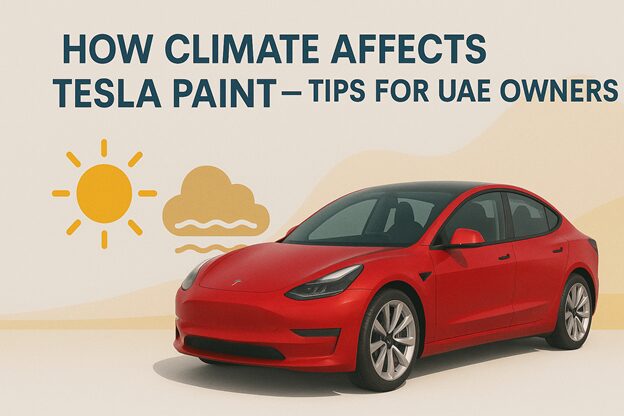
How Climate Affects Tesla Paint — Tips for UAE Owners
The United Arab Emirates presents one of the world’s most challenging environments for automotive paint preservation, and Tesla owners throughout the region quickly discover that maintaining their vehicle’s pristine finish requires understanding and adapting to the unique climate conditions. The combination of extreme temperatures that regularly exceed 50°C during summer months, intense UV radiation at levels among the highest globally, fine desert sand particles that act as microscopic abrasives, occasional violent sandstorms, and coastal humidity that creates corrosive conditions represents a perfect storm of factors that accelerate paint degradation. While Tesla’s advanced multi-layer paint technology provides excellent initial quality and incorporates sophisticated UV protection and environmental resistance, the relentless assault from UAE climate conditions can overwhelm even the most advanced automotive finishes without proper care and protection. Understanding how specific climate factors affect Tesla paint and implementing appropriate preventive measures enables owners to preserve their vehicle’s appearance, protect resale value, and minimize the need for costly interventions at a tesla bodyshop in dubai.
The Devastating Impact of Extreme Heat and UV Radiation
The UAE’s extreme temperatures and intense solar radiation create the most significant threats to Tesla paint longevity and appearance retention. During peak summer months, ambient temperatures regularly exceed 45°C in shaded areas, while direct sunlight exposure drives surface temperatures on vehicle paint to 70-80°C or higher. These extreme temperatures cause multiple forms of paint degradation that progressively compromise appearance and protective properties.
UV radiation at the wavelengths most damaging to automotive paint reaches extreme levels in the UAE due to the region’s low latitude, minimal cloud cover, and extended sunshine duration throughout the year. Ultraviolet light causes photochemical breakdown of the polymer chains that form the structural backbone of clearcoat and basecoat layers. This breakdown process, called photodegradation, gradually destroys the paint’s molecular structure, leading to oxidation that manifests as loss of gloss, chalky surface texture, and color fading.
The clearcoat system on Tesla vehicles, while formulated with UV absorbers and stabilizers designed to mitigate photodegradation, faces UV exposure levels that exceed typical design parameters. Over time, the protective additives become depleted through sacrificial absorption of UV energy, after which degradation accelerates. Clearcoat oxidation creates a progressively rougher surface texture as polymer degradation produces microscopic surface irregularities that scatter light rather than reflecting it smoothly, resulting in the dull, hazy appearance characteristic of weathered paint.
Color pigments in basecoat layers also suffer UV damage, though modern organic pigments used in automotive applications demonstrate improved stability compared to older formulations. Red pigments historically exhibited the poorest UV resistance, though Tesla’s paint formulations incorporate advanced pigment technologies that provide better durability. Metallic finishes face additional challenges as clearcoat oxidation obscures the aluminum flake particles that create the characteristic sparkle effect, causing the finish to appear flat and lifeless even when underlying color remains relatively stable.
Extreme heat accelerates all chemical degradation processes, effectively speeding up the aging timeline for automotive paint. The high temperatures experienced by vehicles parked outdoors in UAE conditions can advance paint aging by factors of two to four times compared to moderate climates, meaning that a Tesla experiencing five years of outdoor exposure in Dubai may exhibit paint degradation equivalent to ten to twenty years in temperate regions.
Protecting Tesla paint from UV and heat damage requires multi-faceted approaches. Covered parking in shaded structures or enclosed garages provides the most effective protection by completely eliminating direct sun exposure during parked periods. When covered parking proves unavailable, using high-quality car covers specifically designed for outdoor use offers substantial protection, though covers must allow moisture evaporation to prevent condensation damage and should incorporate soft inner linings that won’t scratch paint during installation or wind movement.
Regular application of high-quality paint sealants or ceramic coatings creates protective barriers that absorb UV radiation before it reaches vulnerable paint layers while providing hydrophobic properties that aid cleaning and reduce environmental contamination adherence. Premium ceramic coatings, professionally applied by qualified car painting in dubai facilities, provide multi-year protection with superior UV resistance, chemical resistance, and self-cleaning properties compared to traditional wax or synthetic sealant products.
Paint protection film (PPF) installation on vulnerable areas provides the ultimate defense against UV damage while simultaneously protecting against stone chips and other physical damage. Modern PPF products incorporate UV inhibitors that prevent yellowing while blocking harmful radiation from reaching underlying paint. Full-body PPF installation represents a significant investment, typically ranging from AED 8,000 to 15,000 depending on coverage area and product quality, but provides comprehensive protection that preserves factory finish condition and maintains resale value.
Sand and Dust Contamination Challenges
The fine desert sand and dust particles prevalent throughout the UAE create constant abrasion threats to Tesla paint surfaces. These microscopic particles, suspended in the air during normal conditions and reaching extreme concentrations during sandstorms, settle on vehicle surfaces where they can cause damage through several mechanisms.
Wind-blown sand particles striking paint surfaces at high velocity create microscopic scratches and pitting that accumulates over time, gradually degrading surface smoothness and gloss. The damage occurs most severely on leading edges and surfaces perpendicular to prevailing wind directions, including hood leading edges, front bumpers, side mirror housings, and door handles. While individual particle impacts cause minimal visible damage, the cumulative effect of millions of impacts progressively dulls the finish and creates a network of micro-scratches visible under close inspection or certain lighting conditions.
Perhaps more significantly, sand and dust particles settling on paint surfaces create hazards during washing and drying procedures. When improper washing techniques involve direct contact with contaminated surfaces, the particles act as abrasives between washing media and paint, creating swirl marks and scratches that become increasingly visible over time. These washing-induced defects often prove more damaging than environmental exposure alone, as repeated improper washing can severely compromise paint appearance within relatively short timeframes.
Dust accumulation in panel gaps, around door seals, and in other crevices can migrate onto paint surfaces during driving or when wind disturbs accumulated deposits. This contamination then contributes to abrasion during subsequent washing or when contacted by objects like sleeves or bags during normal vehicle use.
Preventing sand and dust damage requires careful attention to washing procedures and protective measures. The two-bucket washing method, utilizing separate buckets for soap solution and rinse water along with grit guards to trap particles at bucket bottoms, minimizes risk of reintroducing contaminants during washing. High-quality microfiber wash media should be used exclusively, with frequent rinsing to remove accumulated particles and prevent abrasion.
Pre-wash procedures become essential in dusty conditions, involving thorough rinsing to remove loose particles before any contact washing occurs. Some Tesla owners utilize foam cannons or snow foam products that create thick foam blankets covering the vehicle, allowing cleaning agents to loosen contamination during dwell time before contact washing begins. This pre-treatment significantly reduces abrasion risk by removing particles before physical contact occurs.
Touchless washing systems, while avoiding abrasion risks from contact media, may prove less effective at removing stubborn contamination and can leave residual particles that create issues during drying. When utilizing touchless washes, careful inspection and hand detailing of remaining contamination becomes necessary before drying to prevent damage.
Professional detailing services specializing in paint care for premium vehicles understand proper decontamination procedures and utilize appropriate techniques and products to safely clean Tesla finishes. Regular professional detailing, perhaps quarterly or semi-annually depending on usage patterns, provides thorough cleaning that removes accumulated contamination while allowing inspection for developing paint issues that may require professional correction.
Paint protection films and ceramic coatings provide substantial benefits in dusty conditions by creating smoother, more chemically resistant surfaces that contamination adheres to less readily and releases more easily during washing. The hydrophobic properties of these protective products cause water to bead and sheet away, carrying contaminants with it and reducing the physical agitation required for cleaning.
Humidity, Salt Air, and Chemical Contamination
The UAE’s coastal regions, including Dubai, Abu Dhabi, and other major population centers, experience high humidity levels and salt-laden air that create corrosive conditions affecting both paint and underlying metal substrates. While Tesla’s extensive use of aluminum body panels provides excellent corrosion resistance compared to steel construction, the paint system remains vulnerable to humidity-related degradation and chemical attack from various environmental contaminants.
Salt particles suspended in coastal air settle on vehicle surfaces where they create hygroscopic deposits that attract and retain moisture. This trapped moisture against paint surfaces creates conditions favorable for chemical reactions that can etch clearcoat, cause water spotting, and potentially initiate corrosion if paint damage exposes underlying metal. The combination of salt, moisture, and elevated temperatures accelerates these degradation processes compared to dry inland conditions.
Water spotting represents a particularly common issue for Tesla owners in coastal UAE areas. The region’s water supply contains significant mineral content including calcium, magnesium, and various salts that remain on paint surfaces after water evaporation. In extreme heat, these deposits can etch into clearcoat layers within hours if not promptly removed, creating permanent damage that requires professional polishing for correction. Repeated water spotting accumulation can significantly degrade paint appearance and consume clearcoat thickness through necessary correction procedures.
Industrial fallout and urban air pollution contribute additional chemical contamination, with various compounds settling on paint surfaces where they can cause discoloration, etching, or bonding that resists normal cleaning. Dubai’s rapid development and industrial activities generate airborne particles and chemical species that affect vehicle finishes, particularly in industrial zones or areas downwind of manufacturing facilities.
Bird droppings, tree sap, and insect residue present acute contamination threats due to their acidic or alkaline chemistry. In UAE’s extreme heat, these biological contaminants can etch deeply into clearcoat within hours of contact, creating permanent damage that requires professional intervention. The combination of chemical reactivity and elevated temperatures makes prompt removal essential for preventing lasting damage.
Protecting Tesla paint from humidity and chemical contamination requires proactive maintenance and protective measures. Prompt removal of any contamination, particularly bird droppings, insect residue, or visible salt deposits, prevents etching damage and maintains paint integrity. Microfiber detailing spray and dedicated quick detailer products enable safe spot cleaning without requiring complete vehicle washing.
After rain exposure or any water contact, thorough drying using clean, high-quality microfiber drying towels prevents water spot formation by removing mineral-laden water before evaporation occurs. Forced-air drying using electric blowers or compressed air provides additional benefits by removing water from crevices and panel gaps where it might otherwise remain and cause issues.
Regular washing with pH-neutral automotive shampoos specifically formulated for modern clearcoat finishes removes accumulated contaminants before they can cause damage. Washing frequency should increase during periods of high humidity, after rain events, or when visible contamination accumulates. Many UAE Tesla owners find that weekly washing provides optimal balance between maintenance burden and paint preservation.
Application of sacrificial protective layers through regular use of spray sealants or detail sprays creates renewable barriers that absorb contamination and can be easily removed through washing, preventing contact with underlying clearcoat. These products require frequent reapplication but provide convenient, cost-effective protection supplementing more durable ceramic coatings or paint protection films.
Temperature Cycling and Thermal Stress Effects
The dramatic temperature variations experienced daily in the UAE create thermal stress that affects paint durability and adhesion. Vehicles parked outdoors overnight may cool to ambient temperatures of 25-30°C, then rapidly heat to surface temperatures exceeding 70°C within an hour of sunrise as solar radiation intensity increases. This rapid temperature cycling causes expansion and contraction of paint layers and underlying substrates that can stress interlayer bonding and accelerate fatigue damage.
Different materials in vehicle construction exhibit varying thermal expansion coefficients, meaning they expand and contract at different rates during temperature changes. Paint layers must accommodate these movements while maintaining adhesion to underlying substrates and cohesion between multiple paint layers. Repeated cycling gradually fatigues paint systems, potentially leading to checking, cracking, or in severe cases, delamination where paint layers separate from each other or from substrates.
The multi-layer paint architecture on Tesla vehicles creates multiple interfaces where thermal expansion mismatches can generate stress. While Tesla’s paint formulations incorporate flexibility to accommodate substrate movement, the extreme temperature ranges and cycling frequencies in UAE conditions exceed typical design parameters. Older vehicles or those with compromised paint systems due to previous damage or improper repairs face higher risk of thermal stress failures.
Covered parking provides the most effective mitigation for thermal cycling stress by moderating temperature extremes and reducing cycling frequency. Vehicles stored in climate-controlled garages experience minimal temperature variation, effectively eliminating thermal stress as a degradation mechanism. Even simple shade structures significantly reduce peak temperatures and slow heating rates, reducing thermal stress severity.
For vehicles requiring outdoor parking, reflective sunshades placed on windshields and rear windows reduce interior temperatures while somewhat moderating exterior paint temperatures through reduced radiant heat transfer. Light-colored vehicles experience less severe temperature extremes than dark-colored vehicles due to higher solar reflectance, though all colors face significant thermal challenges in UAE conditions.
Practical Maintenance Tips for UAE Tesla Owners
Implementing comprehensive paint care strategies adapted to UAE conditions enables Tesla owners to preserve their vehicle’s appearance despite harsh environmental challenges. Regular washing using proper techniques and premium products removes contamination before it causes damage, while immediate attention to any acute contamination like bird droppings prevents etching. Covered parking whenever possible provides the single most effective protection measure, with investment in permanent covered parking structures proving cost-effective compared to paint correction and repair expenses over vehicle ownership periods.
Professional paint protection measures including ceramic coatings and paint protection film provide substantial benefits that justify their initial investment through reduced maintenance requirements and preserved paint condition. Many UAE Tesla owners find that combining full-front PPF coverage protecting the most vulnerable areas with full-body ceramic coating provides optimal balance between comprehensive protection and reasonable investment, with typical combined costs ranging from AED 6,000 to 12,000 depending on product quality and coverage extent.
Regular inspection of paint condition, particularly after extreme weather events or when visible contamination occurs, enables early detection of developing issues before they require extensive correction. Quarterly or semi-annual professional detailing sessions provide thorough cleaning, decontamination, and inspection while allowing reapplication of sacrificial protective layers. These professional services typically cost AED 300 to 800 per session but provide value through proper technique execution and expert assessment.
When paint damage occurs despite preventive measures, prompt professional correction through qualified tesla bodyshop in dubai facilities prevents minor issues from developing into major problems requiring extensive repair. Stone chips should be addressed quickly to prevent corrosion initiation, while environmental etching or contamination damage may be correctable through polishing if caught early before it penetrates deeply into clearcoat layers.
Understanding how UAE climate conditions specifically affect Tesla paint enables owners to implement appropriate protective measures and maintenance routines that preserve their investment. While the extreme environment presents significant challenges, proactive care and professional protection measures ensure that Tesla vehicles maintain their distinctive appearance throughout their service lives, providing both aesthetic satisfaction and protected resale value in one of the world’s most demanding automotive environments.