What should companies look for when choosing a storage facility in the UAE?
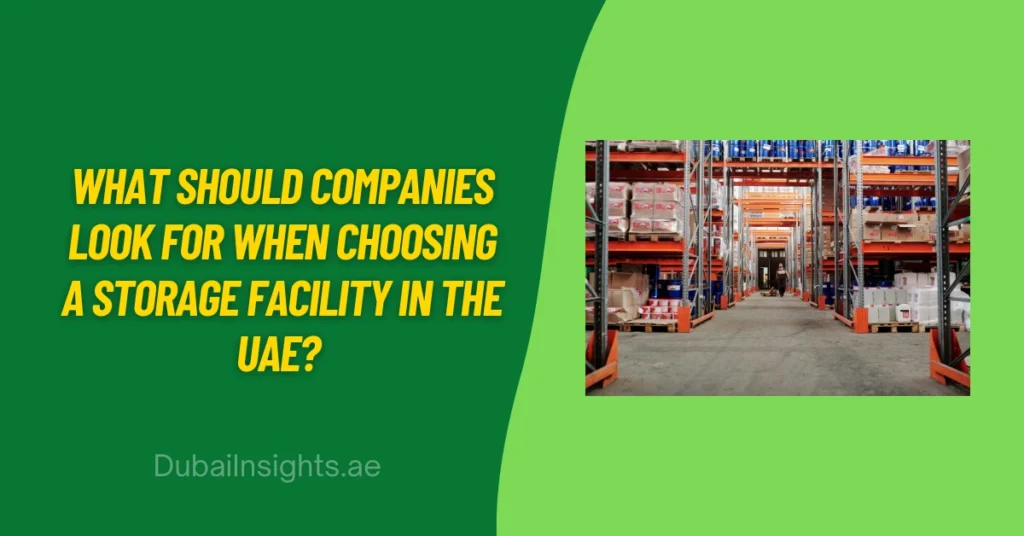
Storage facility selection for businesses in the UAE is more than just a question of free floor space. The right facility should protect inventory, be flexible to changing needs, and facilitate the movement of goods as much as possible.
This is especially true in Dubai, where businesses are spread across commercial and industrial areas such as Al Quoz, Jebel Ali, JAFZA, and Dubai Industrial City.
Elsewhere in the UAE, depending on their suppliers, customers, and distribution routes, companies might have different priorities.
Accessibility & Location
The location of storage will directly affect how practical and how costly it will be. A facility may be more cost-effective, but if it is not well situated in relation to the business operations, the expense of frequent collections and deliveries may be inefficient.
For example, companies in and around Jebel Ali and JAFZA might want to focus on access to the port and the main freight routes. One company may want good access to central Dubai (such as those in Al Quoz) while another company may have different distribution needs (such as those around Dubai Industrial City or DIP).
If you are a business looking for storage space in Umm Al Quwain, you should not only think about the location of the facility, but also if the provider can effectively manage collection, storage and delivery to the area. So, the best location is not only the closest one. The site that lets the larger flow of goods happen efficiently.
Flexibility and Capacity
Storage needs are seldom the same all year. You might need to increase your inventory at certain times of the year, or your business might move, and you suddenly need more space because your current premises can no longer hold your stock, furniture, or equipment.
Therefore, businesses need to look for a facility that can accommodate current and changing needs.
Business storage solutions allow companies to have extra capacity without having to take on a larger premises than they need. This can be a great option for companies that do not need a permanent warehouse.
Protection and Security
Because commercial inventory can be a large investment, security is an important factor in choosing a facility. Businesses need to consider things like CCTV surveillance, controlled access, perimeter security, and fire protection.
The general condition and management of the facility should be taken into account as well. A professional storage operation should have clear procedures for receiving, handling, and protecting goods, not just a space where items can be put.
This is especially important if you are planning to store furniture, equipment, documents, or valuable commercial inventory for a long period of time.
Storage Conditions
Some goods may have different storage requirements. The conditions for storing furniture, electronics, documents, equipment, and packaged inventory may differ depending on the material, condition, and length of time to be stored.
So, businesses need to ensure that the storage environment is appropriate for the goods being stored. This is especially true for long-term storage, where the wrong conditions can affect the condition and usability of the stored assets.
Storage: Short Term or Long Term?
How long you keep it is contingent upon why you need the room.
Short-term storage can be helpful if a business is:
- Manage surplus inventory
- Changing locations
- Management of seasonal stock
- Renovations complete
- Experiencing temporary capacity crunch
Furniture, equipment, archived materials, inventory, or other business assets that are not needed on a regular basis but still need to be kept safe and accessible may be more appropriate for long-term storage.
The important question is not how long the goods will be stored, but how they will have to be handled while stored.
Delivery, Handling, and Access
Storage becomes more useful when it can be accessed efficiently when needed. Businesses need to know how inventory is received, organized, and released before choosing a facility. Also worth considering is whether the provider can support loading, unloading, collection, and delivery.
For many businesses, storage is just one piece of a larger operational need. In the end goods may have to be collected from an existing premise, transported to storage, and delivered elsewhere.
Managing these stages with different providers may add complexity in terms of communication and handling. Much of this process can be made much easier with a storage and logistics arrangement that is integrated.
Warehouse or Professional Storage
Having a dedicated warehouse can make sense for businesses that have large and predictable storage needs.
But it also brings extra responsibilities such as premises management, staffing, security, and ensuring sufficient capacity.
Professional storage can be a practical alternative when a business needs more space but doesn’t want to commit to a larger permanent facility.
May be appropriate for:
- Expanding businesses
- Companies with variable inventory
- Seasonal Inventory
- Business on the go
- Furniture & Equipment Storage
- Capacity needs in the short term
- Businesses needing storage as well as transport
The correct choice will depend on the volume of goods, the storage period, access frequency, and wider operational requirements.
Questions to Ask Before Selecting a Storage Facility
Before signing up with a provider, businesses should think about:
- Is the location convenient to our operations?
- Is there enough capacity?
- Is this arrangement flexible enough to meet changing needs?
- What is the security and fire protection?
- Is the storage condition good for our goods?
- How easy is it to get inventory back?
- Can we arrange collection & delivery?
- Do you have short-term and long-term options?
- Is the facility equipped to handle the type and volume of goods we need to store?
These questions help differentiate between a space provider and a storage provider that can truly power the business.
Selecting Storage in the UAE
No one storage solution works for every business. The needs of a company holding seasonal inventory can be very different from the needs of a company holding furniture, equipment, or commercial stock for several years.
Location should therefore be taken into account, but also security, storage conditions, flexibility, and logistics.
Whether the company is based in and around Al Quoz, Jebel Ali, JAFZA, Dubai Industrial City, DIP, or Umm Al Quwain, the aim is the same—to find storage capacity that protects its assets while making them practical to handle. The best storage facility should do more for a business than being a place to put goods. It ought to facilitate the handling of those goods.