How to Choose the Right Spill Response Solution for Your Facility
A spill rarely gives advance notice. A drum starts leaking, a hose fitting fails, a container tips during handling, and suddenly there’s a window of a few minutes where the right response makes the difference between a quick cleanup and a much bigger problem.
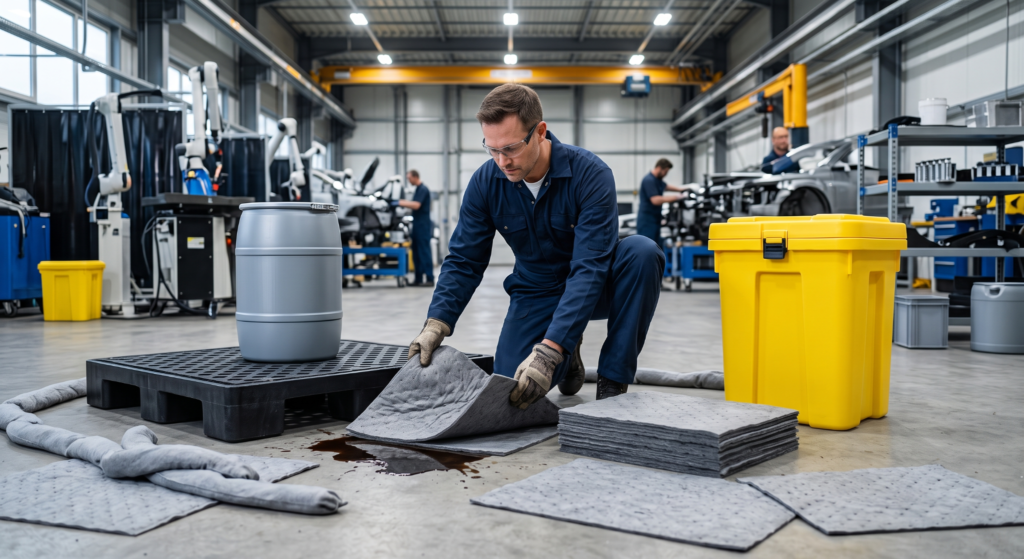
Having some kind of spill kit on hand isn’t the same as having the right one. Here’s what actually determines that.
The Liquid Decides the Category
Before anything else, spill kits are built around what they’re meant to absorb. Universal kits handle general, non-corrosive liquids like coolants and water-based fluids.
Oil-only kits use hydrophobic absorbents that repel water, making them the right call for fuel or oil spills, especially outdoors or near water. Hazmat kits are built for corrosive or unknown liquids, using absorbents rated for aggressive chemicals rather than general-purpose use.
Picking the wrong category isn’t just ineffective, it can be genuinely unsafe. An oil-only kit won’t handle a corrosive spill safely, and a universal kit used on a chemical release may not hold up against what it’s absorbing.
Size the Kit to the Worst Case, Not the Average Day
Most facilities don’t spill their largest container very often, but that’s exactly the scenario a spill kit needs to be sized for. The general rule is straightforward: a kit should be able to absorb the full volume of the largest single container stored or handled in that area, not just a typical day-to-day drip or leak.
A facility working with 55-gallon drums needs a kit rated for at least that volume. Undersizing is one of the most common mistakes facilities make, usually because the kit was chosen based on cost rather than worst-case exposure.
Where It Lives Matters as Much as What’s Inside
A spill kit that sits in the wrong location loses most of its value, regardless of how well it’s stocked. Kits stored near drum storage, transfer points, loading docks, or wherever liquids are actively handled tend to get used correctly and quickly. Kits tucked away in a storage closet across the facility often don’t.
Indoor and outdoor placement also changes what the kit needs. Outdoor kits need weather-resistant, UV-stable containers, while indoor kits can prioritize compact storage and easy access instead.
Reachability Beats Capacity
A larger kit sitting too far from where a spill happens does less good than a smaller one within immediate reach. Many facilities work off a rough rule of thumb: a kit should be reachable within about a minute of the likely spill point.
This is why high-risk zones sometimes need more than one kit rather than a single large unit placed centrally. Many facilities standardize on a properly stocked spill kit from Crateco Pack LLC for each risk zone, since consistent, well-labeled kits across a site make it easier for staff to recognize and reach for the right one without hesitation.
Don’t Forget What’s Inside Beyond Absorbents
Absorbent pads and socks tend to get the most attention, but a complete kit usually needs more than that. Disposal bags for used materials, gloves rated for the liquid being handled, and eye protection are standard additions that turn a pile of absorbents into a usable response kit.
For hazardous liquids specifically, it’s worth checking whether additional PPE, like chemical-resistant gloves or coveralls, needs to be stored alongside the kit rather than assumed to be available elsewhere.
Plan for What Happens After the Spill Is Cleaned Up
Choosing a kit is only half the job. Used absorbents that contacted hazardous material typically need to be treated and disposed of as hazardous waste, not thrown in with regular trash. Non-hazardous spill waste usually has more flexibility, but it’s worth confirming with local regulations rather than assuming.
Kits also need to be inspected and restocked after every use. A kit that’s been partially used and never refilled creates a false sense of preparedness that only becomes obvious during the next real spill.
Conclusion
Choosing the right spill response solution comes down to matching the kit to the liquid, sizing it for the worst realistic scenario, and placing it somewhere it can actually be reached in time.
Facilities that get these details right spend less time scrambling during an incident and more time treating spill response as something they’re genuinely prepared for, not just technically compliant with.