Evaluating Peptide Suppliers Through Published Batch Reports
Research-use-only notice: the materials discussed here are for in-vitro laboratory research only. They are not for human or veterinary use, and nothing in this article is medical advice.
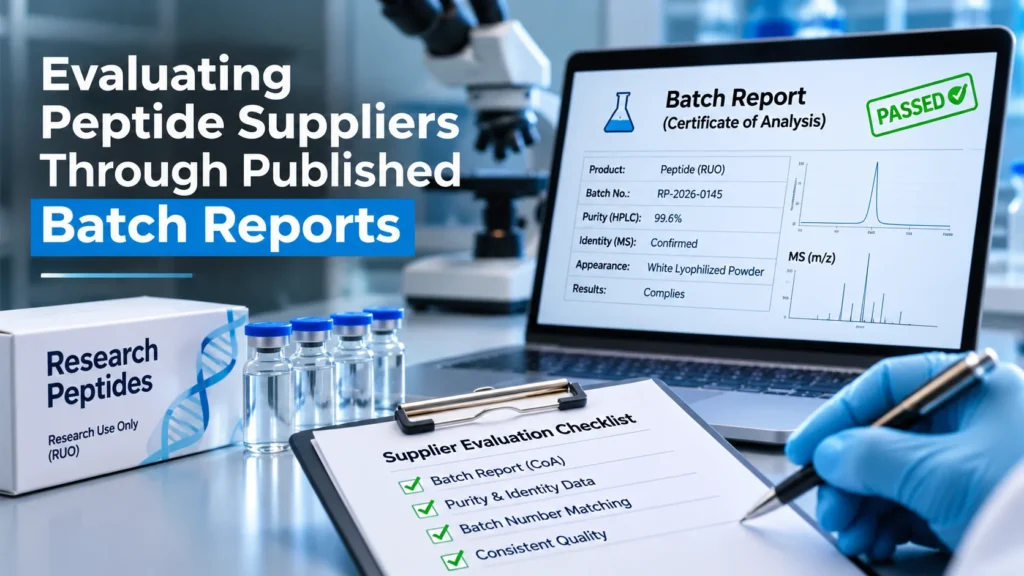
Search for research peptides Dubai suppliers offer and you will find dozens of storefronts that look alike. Clean photos, confident copy, a purity claim near the top. Price and delivery speed are easy to compare. Reliability is harder, and the best evidence available to an outside buyer is the one thing many sellers do not publish: their batch reports.
This article proposes a simple method for comparing suppliers using the records they put in public. It does not rank anyone. It gives you a set of questions you can apply to any seller, and a way to score the answers.
Why Published Reports Are the Best Starting Point
A supplier can say anything on a product page. A published laboratory report is different because it names a laboratory, a batch, a date, and a list of tests, and because a careful reader can check it. That makes it a fairer basis for comparison than marketing language.
Publication also reveals behaviour. A supplier that posts reports, explains their limits, and corrects mistakes is showing you how it handles information. One that offers only a headline percentage is showing you something too.
Six Questions to Ask of Any Supplier
1. Can each report be traced to a batch?
Look for a batch or lot number on the report and the same identifier on the product record. Reports tied only to a product name cannot be traced, and anything you cannot trace is hard to rely on.
2. Is the laboratory named, and is it independent?
A report from a named third-party laboratory carries more weight than an unsigned internal summary. Note who the laboratory is, where it is based, and how it can be contacted. Some suppliers also run in-house tests alongside third-party ones. That is reasonable, provided the two are not blurred together.
3. Can the report be verified?
Ask what route exists to confirm authenticity. Some laboratories issue a task number and a verification key that open their own copy of the report. Others issue a report number and a signed PDF, which you compare field by field and confirm by writing to the laboratory. Either route is acceptable. No route is a problem.
4. What was tested, and what was not?
Read the test list before the results. HPLC purity and content are common. Endotoxin, heavy metals, residual TFA, microbial counts, and LCMS screening appear on a smaller set of reports. Identity by mass spectrometry is a separate question again. A supplier that tells you plainly which reports include which tests is easier to evaluate than one that implies every batch has every test.
5. Does the report match the product you are buying?
Check the format and strength that were tested. Where a supplier links a report tested in one format to a product in another, the better practice is to say so. Remy Research, for example, labels each product’s link as either an exact format match or supplier-mapped, and states that each report covers the tested batch, not the current shipping lot. Whatever supplier you look at, that kind of statement is the standard to look for.
6. How does the supplier handle limits and corrections?
Look for a plain statement of what reports do not show, and for a methodology or corrections page. As of late October 2026, the supplier above lists eleven published batches with twenty reports, a downloadable dataset, and pages on methodology and updates. Volume alone proves little, but the existence of a visible correction process tells you the records are meant to be maintained.
You can see how a supplier can lay these out in its published peptide lab reports, then apply the same six questions to any other seller you are considering.
A Simple Scoring Table
Give each supplier a score from 0 to 2 on each question: 0 for no evidence, 1 for partial, 2 for clear and checkable.
| Question | Score |
| Traceable to a batch | 0 / 1 / 2 |
| Independent laboratory named | 0 / 1 / 2 |
| Verification route available | 0 / 1 / 2 |
| Test scope disclosed | 0 / 1 / 2 |
| Format and lot limits stated | 0 / 1 / 2 |
| Corrections and methodology visible | 0 / 1 / 2 |
Treat the total as a prompt for further questions, not a verdict. A supplier scoring low on verification, for example, deserves a direct request for a route before you order.
What Even the Best Records Cannot Prove
Strong documentation has boundaries, and honest suppliers state them:
- A report applies only to the identified sample or batch.
- A purity result does not establish sterility or safety for human use.
- A laboratory report is not a regulatory approval and does not by itself show compliance with UAE requirements.
- Buyers remain responsible for local regulations, handling requirements, and institutional research policies.
If a supplier’s materials suggest otherwise, treat that as a warning.
Red Flags in Supplier Records
- Purity numbers with no document behind them
- Reports with no batch number, no laboratory name, or no date
- “Certified” or “verified” claims with no explanation of what was verified
- A single report presented as covering every strength and format
- Language about use on people or animals, or about dosing or administration, on a site that also says “research use only”
- Reluctance to answer questions about batch assignment
Common Mistakes When Comparing Suppliers
Comparing purity figures across different methods. Laboratories report differently, so the same number may not mean the same thing.
Rewarding the longest list. More reports are only better if they are traceable and relevant to the batch you are buying.
Ignoring dates. Evidence that predates the current supply is background, not confirmation.
Skipping the verification step. The check takes minutes and removes the most basic doubt.
FAQs
How do I compare research peptide suppliers in the UAE?
Compare their published batch reports on traceability, laboratory independence, verification routes, test scope, format matching, and how they handle limits and corrections.
Is a published lab report proof of quality?
It is evidence about the tested sample or batch. It does not prove the quality of every later lot, and it does not establish safety for human use.
What if a supplier will not provide a batch report?
Ask once more for the report tied to your batch. If none exists, treat the product as undocumented and weigh that in your decision.
Are these materials for human use?
No. They are supplied for in-vitro laboratory research only and are not for human or veterinary use.
Conclusion
Comparing suppliers is easier when you stop reading adjectives and start reading records. Trace the batch, name the laboratory, check the verification route, read the test list, match the format, and note how the supplier handles its own limits. Buyers who apply those six questions consistently end up with a shortlist built on evidence, and a clear sense of which sellers are willing to be checked.
These materials are supplied for in-vitro laboratory research only. Not for human or veterinary use.